

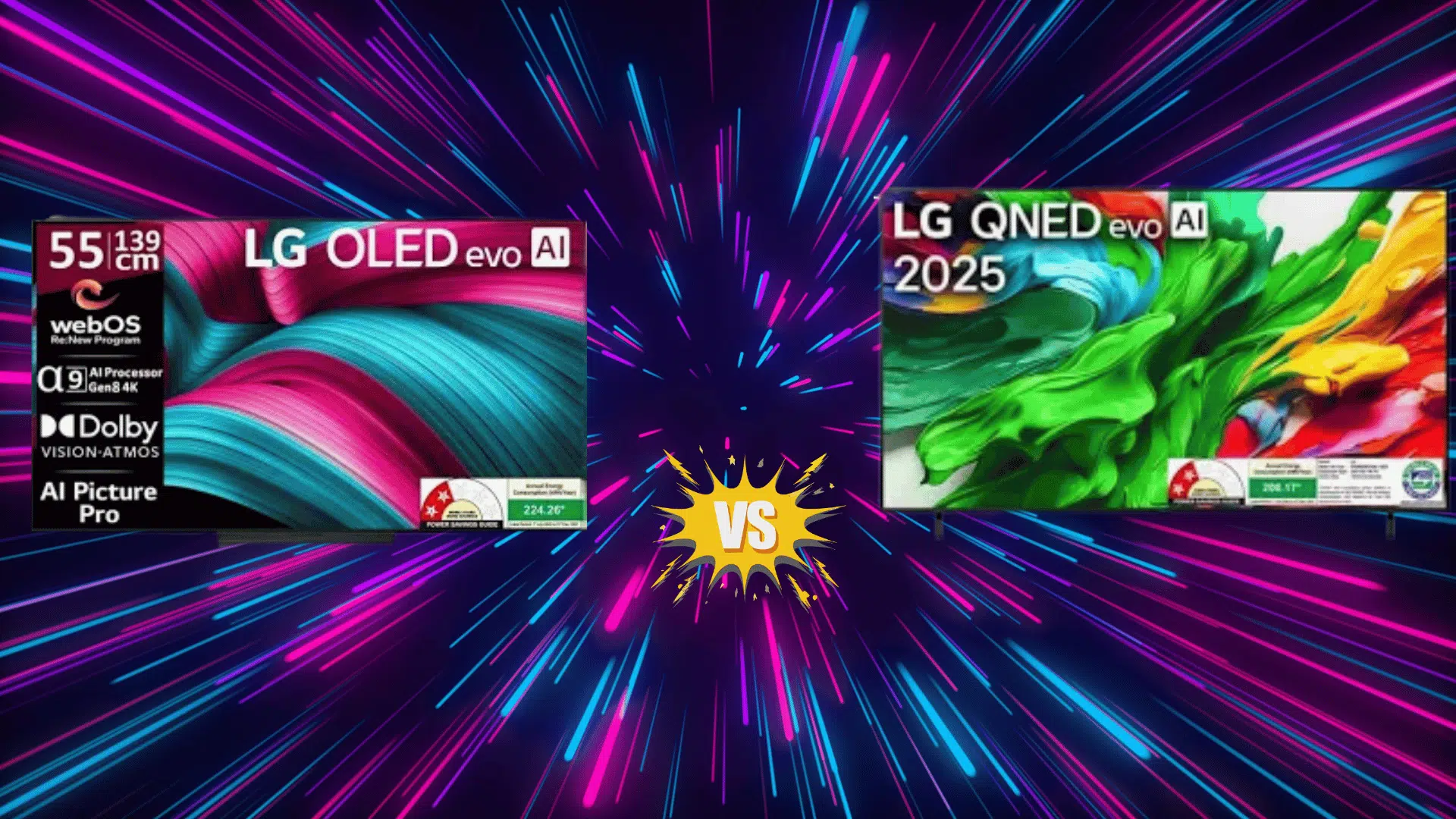




Walk into any electronics store, and you’ll hear the same debate: QNED vs OLED. Both promise great picture quality, but they go about it in very different ways.
That’s where most buyers get stuck. Specs sound impressive, yet real-world performance can feel confusing.
This blog keeps things simple. I’ll break down what actually matters, how each tech performs in everyday use, and where each one makes sense.
By the end, you’ll have a clear idea of which TV fits your space, your habits, and your budget.
Basic Overview of QNED & OLED
QNED and OLED take very different approaches to how a TV produces an image.
OLED has been around longer in the premium market, with LG first bringing it to consumers around 2013, and brands like Sony and Panasonic also using OLED panels in their high-end models.
It works without a backlight, as each pixel lights up on its own, which helps deliver deep blacks and strong contrast.
QNED, introduced by LG in 2021, builds on traditional LED TVs by combining Quantum Dot and Mini-LED backlighting to boost brightness and color. It is mainly used by LG.
In simple terms, OLED emphasizes precision and contrast, while QNED emphasizes brightness and scalability.
QNED vs. OLED: Key Specs Comparison
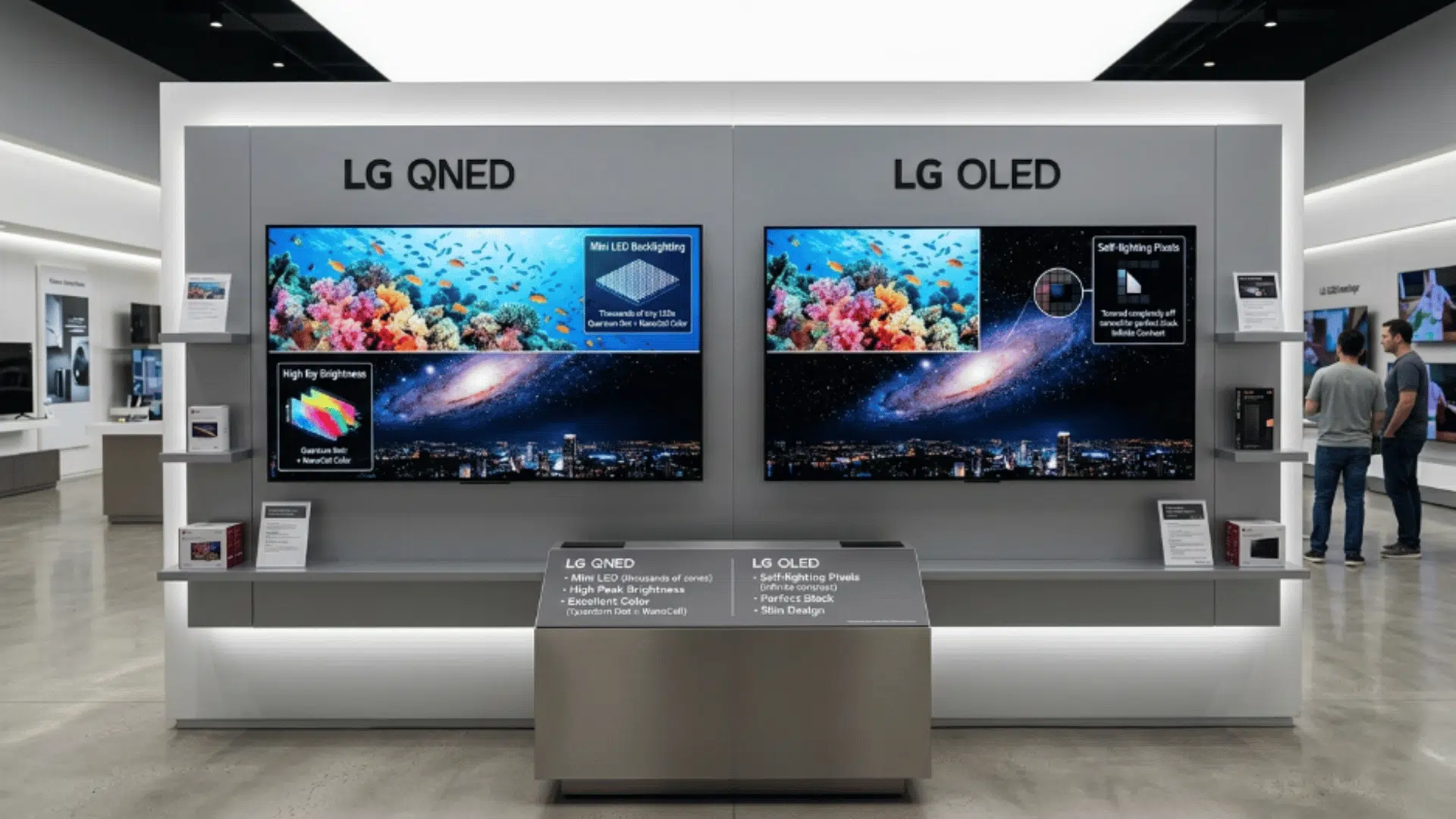
When comparing QNED vs OLED, the real difference shows up in how these TVs handle everyday viewing.
Specs on paper can look similar, but once you understand what they mean in practice, it becomes much easier to choose the right one.
1. Display Technology
OLED uses self-emissive pixels, so each pixel emits its own light and can be completely turned off. This allows for very precise control over the image, especially in darker scenes.
QNED works differently. It uses an LCD panel with a Mini-LED backlight system, where thousands of small LEDs control brightness in zones.
While this is a big step up from standard LED TVs, it still cannot match the pixel-level control of OLED TVs.
2. Contrast Ratio
Contrast is where OLED clearly stands out. Since pixels can turn off entirely, blacks look truly black, not gray.
This makes shadows, night scenes, and depth look more realistic.
QNED still performs well thanks to local dimming, but because it controls light in zones, you may notice a slight glow around bright objects on dark backgrounds.
For casual viewing, it is fine, but side-by-side, the difference is noticeable.
3. Brightness
OLED offers sufficient brightness for most living rooms, especially when lighting is controlled. However, it is not designed to fight strong sunlight.
QNED offers much higher brightness levels, making it a better choice for bright spaces or daytime viewing.
If your TV sits in a room with large windows or lots of light, this difference matters more than most people expect.
4. Color Accuracy
OLED is known for its natural color reproduction. Skin tones, shadows, and subtle gradients look more lifelike, which is why movie fans often prefer it.
QNED, with its Quantum Dot layer, delivers more vibrant, saturated colors. This can make content look more lively, though it can sometimes be slightly less accurate, depending on settings.
5. Viewing Angles
OLED keeps its picture quality consistent even when viewed from the side. Colors stay stable, and contrast does not drop off much. This makes it ideal for larger seating areas.
QNED performs best when viewed head-on. As you move to the side, colors can fade slightly, and contrast may reduce, which can be noticeable in wider rooms.
6. Lifespan
OLED panels rely on organic materials, which slowly degrade over time. In real use, this is rarely a major issue, but it is still something to consider for long-term use.
QNED, based on LCD technology, tends to last longer and does not experience the same types of wear. It is generally seen as a safer option for heavy, long-hour usage.
QNED vs. OLED vs. QLED: What Sets Them Apart
A side-by-side comparison makes it easier to see how QNED vs OLED and other popular TV types actually differ in real-world use, especially when you look beyond just specs.
| Feature | LG C3 OLED 55-inch | LG QNED80 55-inch | Samsung Q60C QLED 55-inch |
|---|---|---|---|
| Display Type | OLED (self-lit pixels) | QNED (Mini-LED + LCD) | QLED (LED + Quantum Dot) |
| Black Levels | Perfect | Very good (some halo effect) | Good (not true black) |
| Brightness | Medium | High | Medium-High |
| Color Output | Natural and accurate | Bright and punchy | Vibrant but less precise |
| Viewing Angles | Wide | Moderate | Moderate |
| Burn-in Risk | Possible (rare with normal use) | None | None |
| Lifespan | Good (organic panel) | Longer (LCD-based) | Longer (LCD-based) |
| Price | $1,000-$1,500 | $500-$900 | $400-$700 |
QNED vs. OLED for Gaming: Which One Is Better?
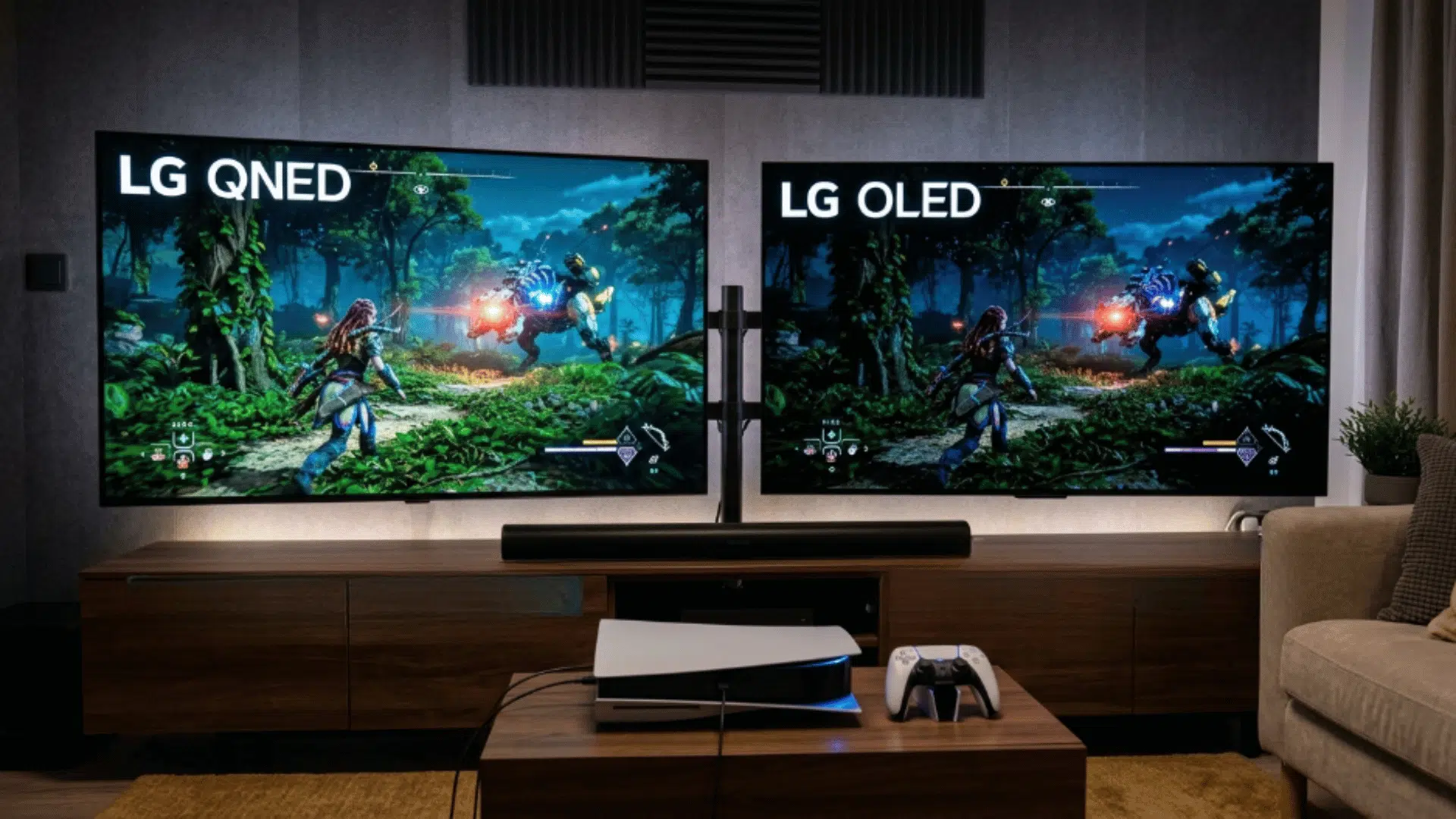
When it comes to gaming, the difference betweenQNED vs OLED is easier to notice than in most other scenarios.
Both support modern consoles and features, but OLED stands out in responsiveness and overall smoothness.
OLED TVs offer near-instant response time, so fast-moving scenes look clean with very little motion blur. This makes a real difference in competitive games where timing matters.
Input lag is also very low, so actions feel quick and precise. QNED still performs well and supports features like 4K at 120Hz, but it cannot match the same level of pixel-level speed.
- OLED delivers near-instant response time for smoother gameplay
- Lower input lag on OLED makes controls feel more responsive
- QNED supports modern gaming features like 120Hz and VRR
- QNED’s higher brightness works better in well-lit rooms
- Slight motion blur can be noticeable on QNED in fast-paced games
Note: OLED is the better pick for serious gaming, while QNED still works well for casual play, especially in brighter spaces.
Community Reviews
Before making a final choice between QNED vs OLED, it helps to look at what real users are saying based on their everyday viewing experience, not just specs on paper.
OLED
I was very impressed with the quality. Crystal clear picture with great contrast. Highly recommended for gaming.- Kristin , Amazon
This is my first OLED TV and all I can say is WOW! If you’ve only had LCD TVs in the past, the OLED difference is very noticeable with the infinite contrast and 3D look that it gives to the image.- Mike ,Amazon
QNED
I wanted a very large HDTV. Check. I didn’t want to go OLED as I had several plasmas and remember ghost images that were hard to go away due to “slight” burn-in. Check. I had read enough about the new very small nano LCD apertures to believe until individually addressable micro led direct view sets become affordable, LG QNED, and Samsung’s similar Quantum Dot panels are the way to go. Check. – John werner, Amazon
The TV itself is great. Looks good, works perfectly, great picture. All the features for the most part are good. My only complaint is the LG platform is not good. The apps seem to work pretty good, like Prime and Pluto, etc. but the LG channels/LG live is just a horrible design, redundancies, poor layout. – Scott, Amazon
Who Should Buy What?
Choosing between QNED vs OLED gets much easier when you match the TV to how you actually use it. Different setups and habits call for different strengths.
| User Type | Best Choice | Why |
|---|---|---|
| Movie lovers | OLED | Delivers deep blacks and strong contrast, ideal for films |
| Bright living rooms | QNED | Higher brightness handles daylight better |
| Gamers | OLED | Faster response time and lower input lag |
| Budget buyers | QNED | More affordable with solid overall performance |
| Sports viewers | QNED | Bright output keeps fast scenes clear in lit rooms |
| Home theater setups | OLED | Better for dark rooms and immersive viewing |
Final Verdict
Choosing between QNED vs OLED comes down to how and where you plan to use your TV.
If picture quality, deep blacks, and smooth gaming matter most, OLED is hard to beat. But if you need higher brightness, longer usage hours, and better value, QNED makes more sense.
There isn’t a one-size-fits-all answer here. The right choice depends on your room setup, viewing habits, and budget.
Focus on what you actually watch and how often you use the TV, and the decision becomes much clearer.
Frequently Asked Questions
Do QNED and OLED TVs differ in energy consumption?
OLED TVs can use less power in darker scenes since pixels turn off individually. QNED may use more energy overall due to constant backlighting.
Is QNED a good upgrade from standard LED TVs?
Yes, QNED is a noticeable upgrade from regular LED TVs. It offers better brightness control and improved color performance.
Are software updates important for TV performance?
Yes, software updates can improve performance and add features. They help both QNED and OLED TVs run smoothly over time.