






Testing problems rarely start with a lack of test cases. More often, teams begin testing before deciding what needs the most attention, which risks matter most, or how different testing methods should fit together.
That is where a software testing strategy comes in. It gives the team a framework for making those decisions before testing gets underway.
I’ve seen projects become much harder to manage when the strategy is reduced to a list of testing techniques rather than used to establish clear priorities.
The distinction is easy to miss, especially when a testing strategy and test plan are treated as the same thing. This piece breaks down how they differ, the main strategy types, and how to choose an approach that fits your software, risks, and release cycle.
What Is A Software Testing Strategy
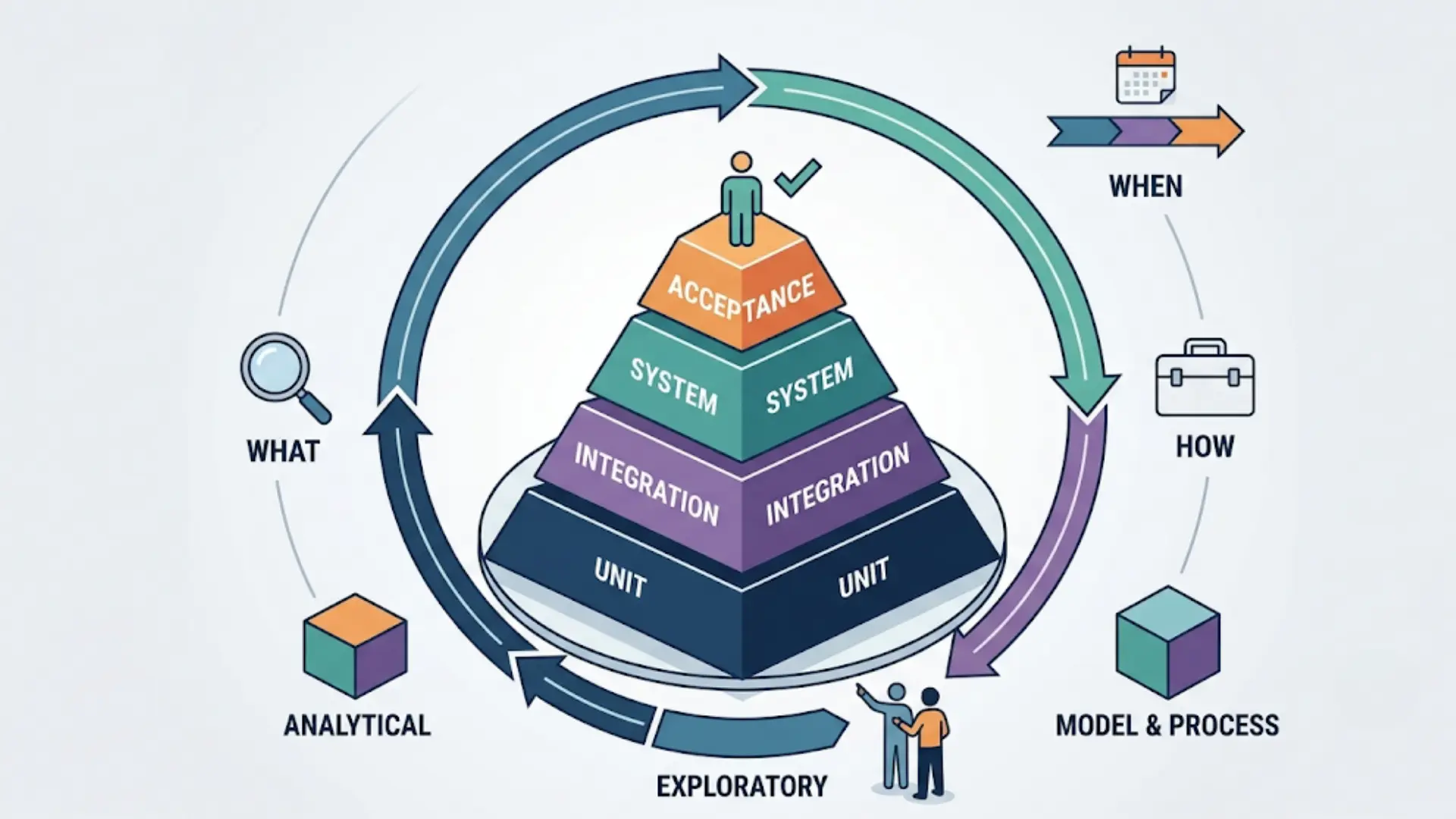
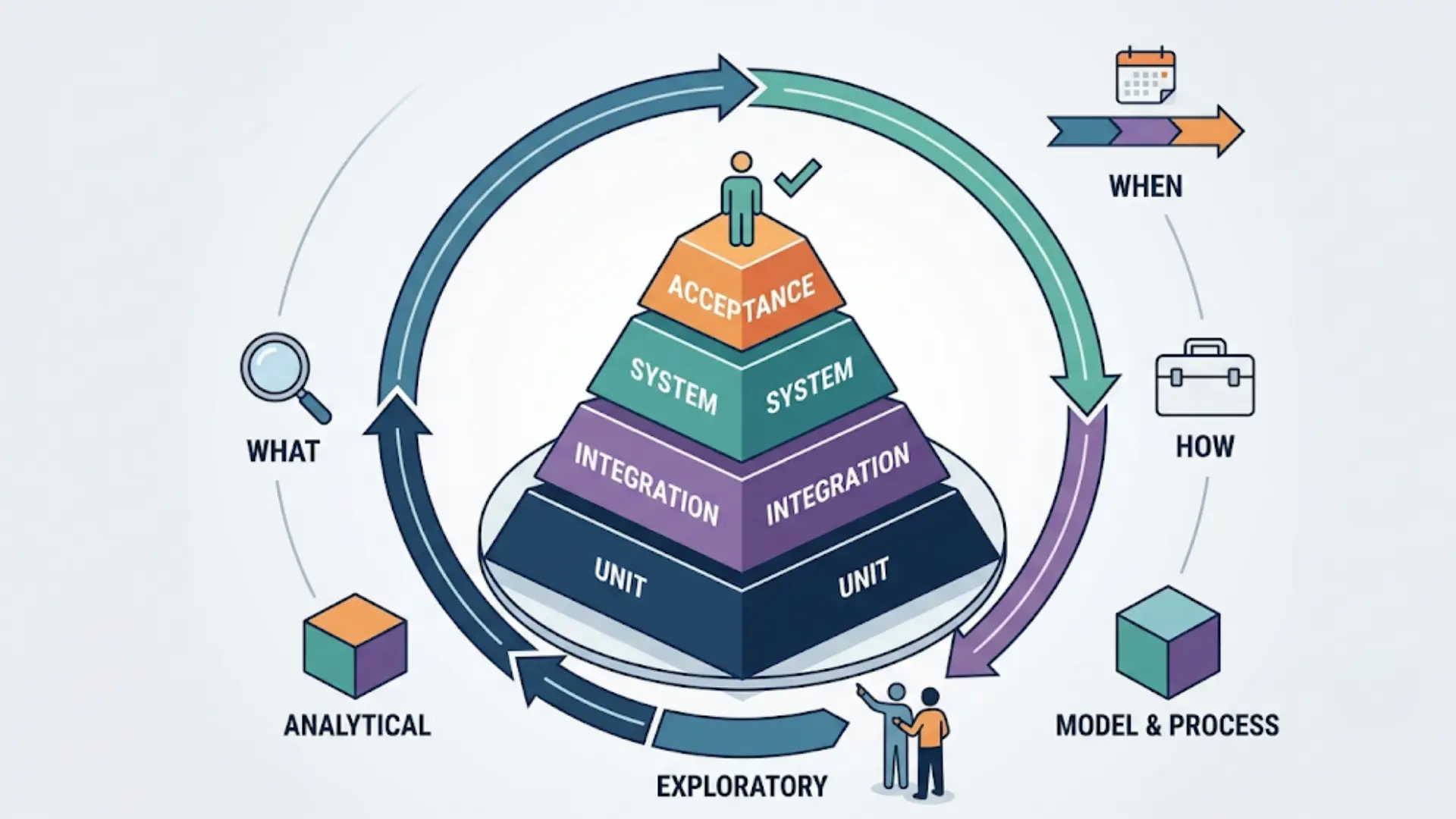
A software testing strategy is a high-level plan that defines what gets tested, how it is tested, and when testing happens. It is set before teams write test cases or choose specific testing tools.
At its core, the strategy answers three simple questions:
- What: what needs testing
- How: how it should be checked
- When: when those checks should happen
These decisions guide the testing work that follows and keep it focused on the same quality goals. On projects with limited testing time, I’ve seen these decisions make the difference between focused coverage and a scattered testing effort.
A strategy is not the same as a test plan. The strategy sets the overall direction, while the test plan explains how testing will be carried out for a specific release or testing cycle.
It is also different from a test type. A test type describes one testing method, while the strategy decides which methods make sense for the software.
This distinction becomes important when teams have broad test coverage but still miss high-impact failures. Testing more does not necessarily mean testing the right things.
Without a clear strategy, testing can turn into a collection of separate checks instead of a coordinated way to judge software quality.
What Are the Main Types of Software Testing Strategies
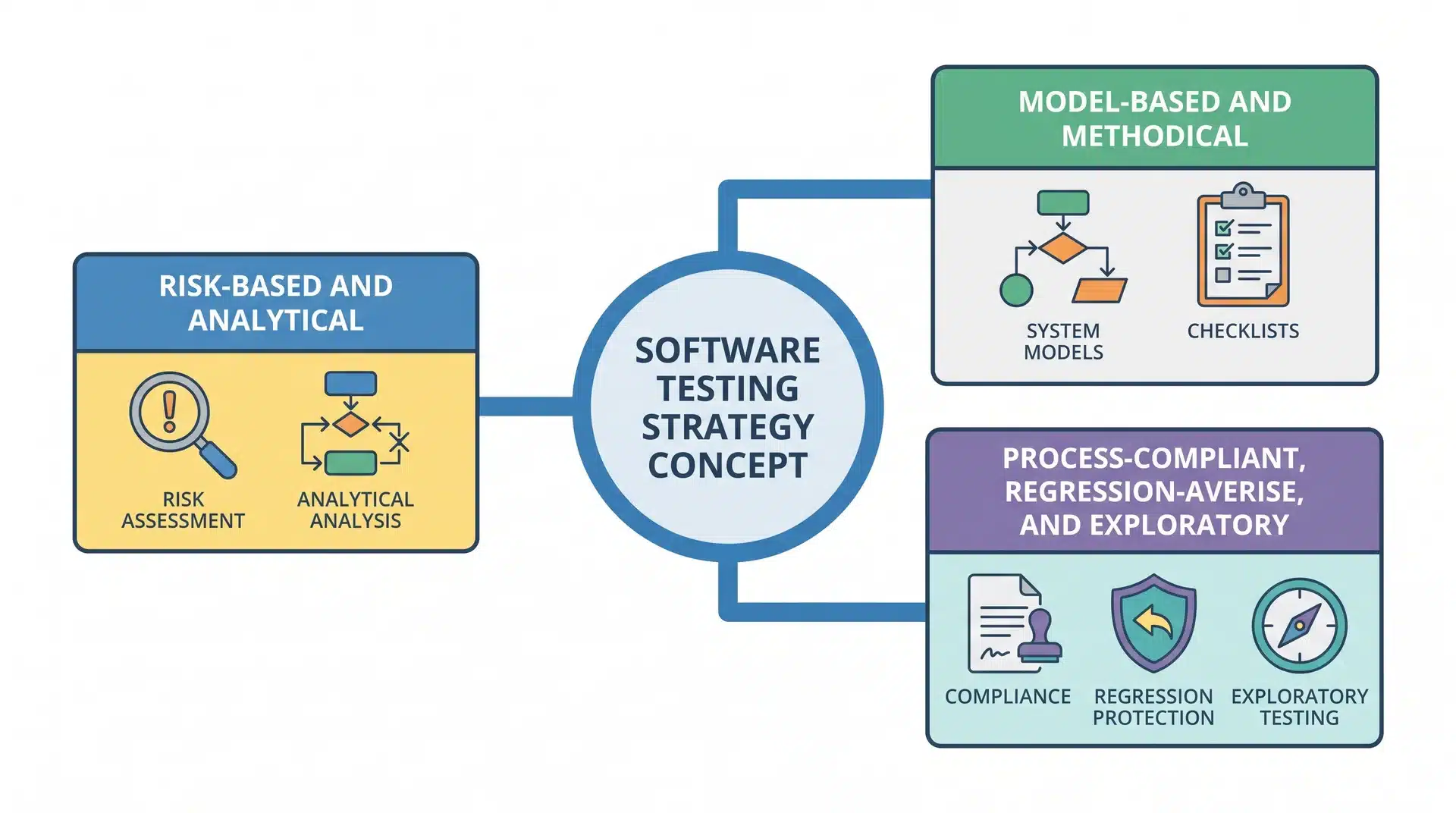
Software testing strategies can be grouped by how they guide testing and what they aim to achieve. Some focus on risk and impact, while others follow a model, a set process, or a specific testing goal.
Strategies That Prioritize By Risk Or Impact
Analytical and risk-based strategies focus on deciding where testing matters most. Analytical strategies use information such as system behavior, requirements, or past defects to decide what deserves more testing.
In practice, I find this approach most useful when testing time is limited. Risk-based strategies put more testing on areas where failures could cause the most harm.
For example, a payment feature may need more testing than a low-impact display setting, so teams do not spend equal effort on every part of the software.
Strategies That Follow A Model Or Structure
Model-based and methodical strategies give testing a clear structure. Model-based testing uses a representation of the system, its behavior, or possible states to guide test design.
A methodical strategy follows a planned set of testing activities, rules, or checklists. This creates consistency across a project and makes the process easier to repeat.
The main difference is straightforward. Model-based testing builds tests around how the system is represented, while methodical testing follows a defined testing process.
Strategies That Optimize For A Specific Outcome
Some strategies focus on a specific goal rather than how tests are selected. Process-compliant testing focuses on meeting required standards, procedures, or compliance rules.
Regression-averse strategies put more focus on preventing existing features from breaking after changes. This is useful for software that receives frequent updates.
Exploratory testing is more flexible. Testers learn about the software as they test it and use what they find to decide where to look next. This can reveal problems that predefined tests may miss.
How Does the Testing Pyramid Connect Strategy to Execution
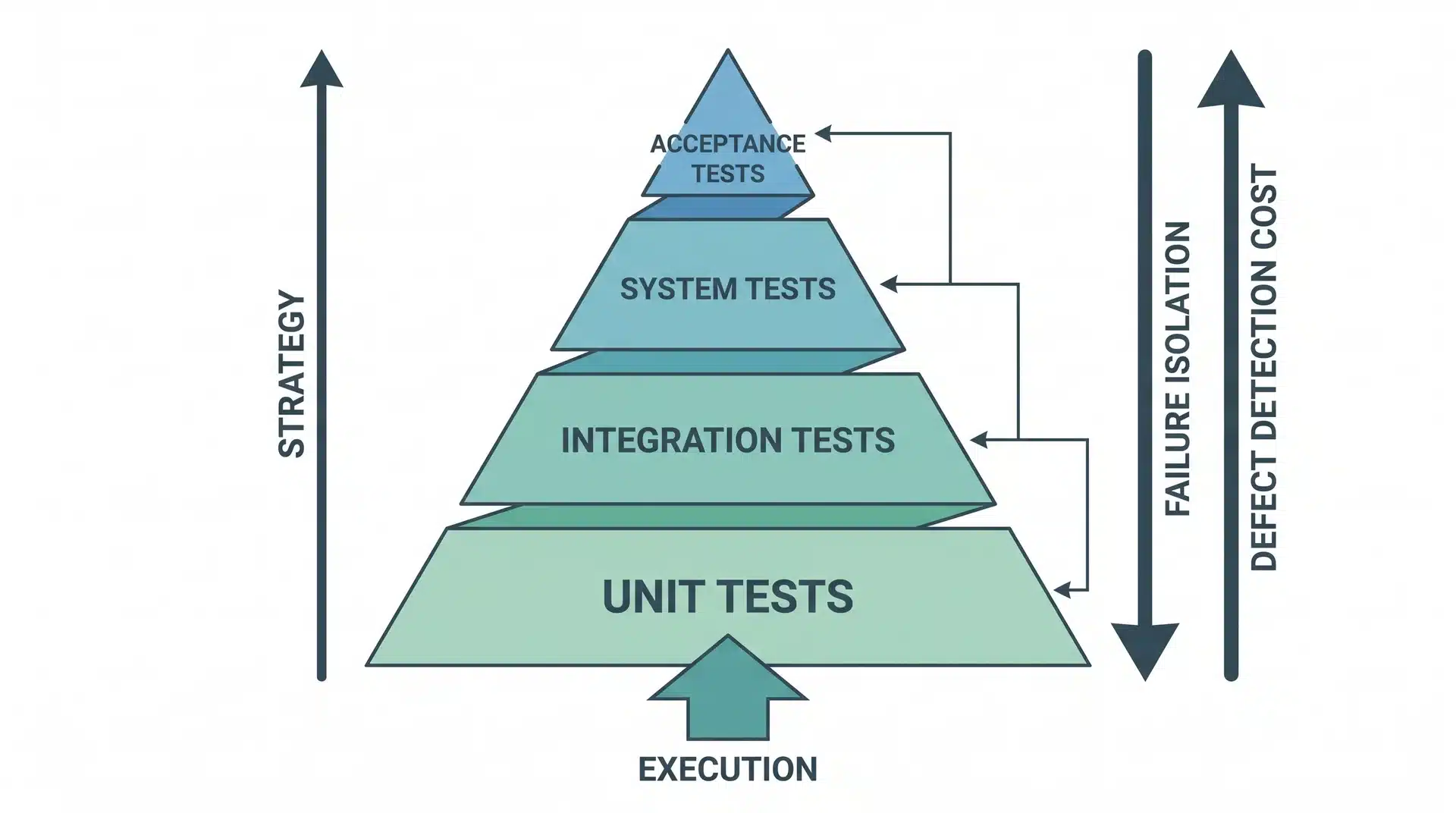
The Testing Pyramid is not a hierarchy of importance. It shows where defects are usually cheapest and fastest to catch.
A testing strategy determines how much effort belongs at each level based on that cost logic. Unit tests sit at the base because they run quickly and isolate failures well.
That does not mean every team needs the same pyramid. The right shape depends on where risk sits in the system.
The Four Levels and What Each Validates
The four levels test software at increasingly broader scopes.
- Unit testing checks individual functions, classes, or components in isolation. It confirms that small pieces behave correctly.
- Integration testing checks whether connected components, services, or dependencies work together as expected.
- System testing validates the complete application against its functional and non-functional requirements.
- User acceptance testing (UAT) checks whether the finished product supports real business needs and expected user workflows.
Why the Shape of Your Pyramid Is a Strategic Signal
A wide unit-test base usually points to a regression-averse strategy. Fast automated checks catch problems early and help protect stable features after each change.
An inverted pyramid tells a different story. When most defects are found during system testing or UAT, they usually cost more to diagnose. I’ve found these failures can also take longer to isolate because several components may be involved.
A process-compliant strategy may lead to a flatter pyramid. More system and acceptance testing may be needed when audits require documented end-to-end evidence.
The classic pyramid also does not fit every architecture. Microservices with complex service contracts may need a larger integration layer because failures can happen between services.
That does not mean the testing is poor. In practice, the pyramid should reflect how the software works and where it is most likely to fail.
How Do You Choose The Right Testing Strategy?
Choosing a testing strategy starts with three questions: what happens if a defect reaches production, what limits the release cycle, and how stable the existing codebase is.
| Factor | What To Consider | Strategy That May Fit |
|---|---|---|
| Defect Impact | High-consequence defects in areas like payments, medical data, or safety need more controlled testing. | Analytical or process-compliant |
| Release Speed | Teams shipping daily need testing that can keep up with frequent changes. | Regression-averse and automated |
| Codebase Stability | Stable code can follow a different approach from software with frequent changes or known problem areas. | Depends on the project |
| Overall Approach | Most projects use one main strategy with other approaches supporting it where needed. | Combination of strategies |
The release cycle also affects how much testing can realistically happen each time. A team shipping daily cannot rely mainly on manual system-level testing for every release.
The goal is not to pick one strategy and use it everywhere. It is to choose the approach that fits the software, its risks, and how often it changes.
Conclusion
A good strategy does more than tell you what to test. It explains why certain areas get tested first, what happens when time runs short, and where human judgment matters more than a script.
I’ve found that teams with a clear reason behind their testing decisions do not always test more. They simply know why they are spending time on one area instead of another.
That is what effective software testing strategies come down to: making sure the assumptions behind your approach fit the project. When they do, the testing work becomes much easier to manage.
If you are building or revisiting a strategy, start by asking where the biggest risks are. That gives you a clear place to make the rest of the testing decisions.
Frequently Asked Questions
What is the difference between a testing strategy and a test plan?
A testing strategy is a high-level decision about what gets tested, at what level, and why it applies across a project or program. A test plan is the execution document that implements the strategy for a specific release or sprint: scope, schedule, resources, and pass/fail criteria. Strategy informs the plan; they are not interchangeable.
What are the 4 types of software testing?
The four foundational levels unit, integration, system, and acceptance testing are not types of strategy; they are levels of execution. A strategy determines how much effort is allocated to each level and in what order. Most testing strategies use all four levels in different proportions depending on project risk and compliance requirements.
What is risk-based testing and when should you use it?
Risk-based testing is a strategy that prioritizes test coverage based on the probability and impact of failure. It’s most appropriate when time or resources prevent exhaustive testing, and the team needs a principled way to decide what to test first. It works best when business stakeholders can clearly identify which features carry the highest consequence if defective.
Can a team use more than one testing strategy at the same time?
Yes, most mature QA programs combine strategies. A team might use an analytical strategy to prioritize test cases while simultaneously running a regression-averse automation layer to protect existing features. The key is knowing which strategy is dominant and ensuring the testing pyramid reflects that priority, rather than stacking strategies without coherent coverage logic.